Menu

How to play

About the game

ZUTOMAYO CARD is a trading card game for two players.

Each player uses a deck of 20 cards. Every turn, both players play cards from their hand and their characters battle. The player who loses the battle takes damage, and the first player to bring the other's HP to 0 wins.

Time is kept on the Chronos, and whether it's night or day changes characters' attack and what effects do.

What you need

All you need here is a deck of exactly 20 cards. Build one in the deck builder.
  • You can have at most 2 cards with the same pack and card number in a deck.
  • It's best for at least half of your deck to be character cards.

How to read a card

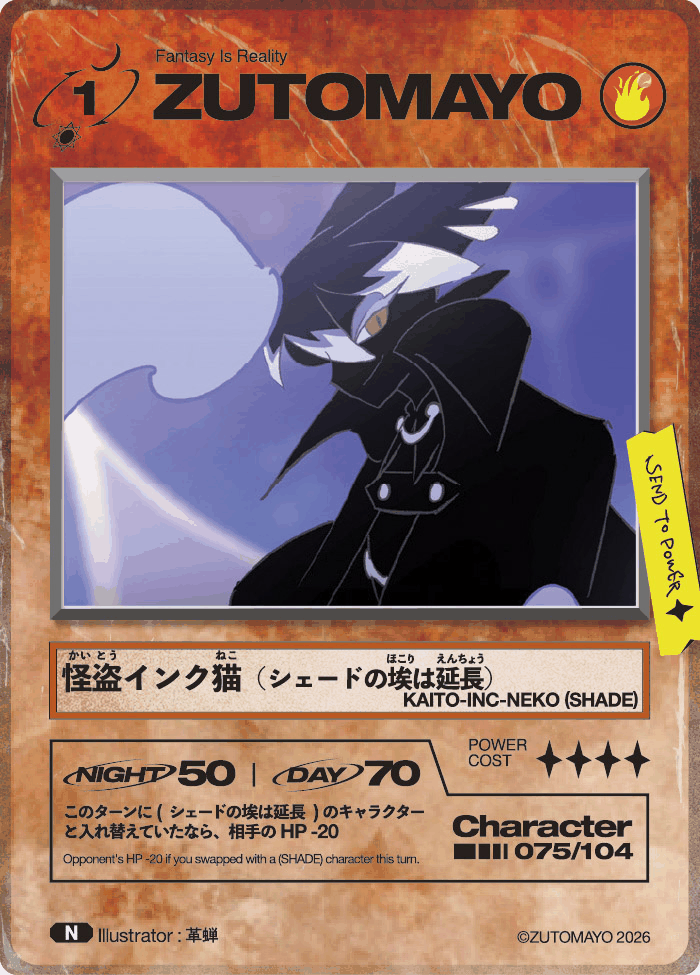
1 2 3 4 5 6 7 8 9 10 11

There are three types of card: Characters, which battle, Enchants, which take effect on the turn they're played, and Area Enchants, which keep taking effect turn after turn. Hover over the numbers to see where each part is.

  1. Card type: Character, Enchant or Area Enchant.
  2. Card name: some different cards share a name. A song in brackets at the end, like (SHADE), is part of the name.
  3. Element: darkness, flame, electric, wind or chaos.
  4. Clock: how far the card moves the Chronos forward when it's played.
  5. Attack: a character's NIGHT and DAY attack. Which one counts depends on the time on the Chronos.
  6. Effect: what the card does.
  7. POWER COST: how much power you need for the card's attack and effect. A character without enough power has 0 attack.
  8. SEND TO POWER: how much power the card gives when it's in your power charger. Not every card has this.
  9. Rarity: this doesn't matter in the game.
  10. Pack: the pack the card is from.
  11. Card number: the card's number in its pack.

The field

The field is where the cards are played. Step through the example to see each part.

  1. Battle zone: where the character that battles goes.
  2. Set zone: where cards played from your hand go, in set zones A and B. Set zone C is for an area enchant whose effect has taken effect.
  3. Power charger: cards with SEND TO POWER go here when they leave the battle zone or set zone. Their SEND TO POWER adds up to your power, and it isn't used up.
  4. Deck zone: where your deck goes.
  5. Abyss: cards without SEND TO POWER go here when they leave the battle zone or set zone.
  6. HP meter: how much HP you have left, out of 100.
  7. Chronos: shared by both players. The medal shows the time, night on the moon side and day on the sun side. The player whose side the medal is on is the priority player, and their effects resolve first.
The field

Getting ready

When a match starts:

  1. Each player chooses a deck of 20 cards.
  2. One player is chosen at random to be on the night side, and the other is on the day side.
  3. The medal starts at midnight on the Chronos, and both players start with 100 HP.
  4. Each deck is shuffled, and each player draws 5 cards.
  5. Mulligan: once, you can choose any number of cards in your opening hand to swap. You draw that many new cards, and the cards you chose are shuffled back into your deck.
  6. Each player chooses a card from their hand to put face down in their battle zone.
  7. Both cards are turned face up at the same time, and the game begins.

If the card you put in the battle zone isn't a character, it goes straight to your power charger or abyss without taking effect, and your attack is 0 on the first turn.

The first turn

  1. Time moves forward: the medal moves clockwise on the Chronos by the total clock of the cards played this turn.
  2. Effects: characters' effects resolve, starting with the priority player. Effects need their power cost to be met.
  3. Attack: if it's night, characters battle with their NIGHT attack, and with their DAY attack if it's day. A character without enough power has 0 attack.
  4. Damage: the player whose character has the lower attack takes the difference as damage. If the attacks are the same, it's a draw.
  5. End of the turn: each player draws as many cards as they played from their hand this turn.
The first turn

Turns after the first

From the second turn, how many cards you can set depends on the last battle: the winner sets 1 card, and the loser can set 1 or 2. After a draw, both players set 1. You always have to set at least 1.

  1. Set cards: choose cards from your hand to put face down in set zones A and B.
  2. Reveal: everyone's set cards are turned face up together. Effects that happen "at the start of the turn" resolve now.
  3. Time moves forward: by the total clock of the cards played this turn.
  4. Character swap: a character you set swaps with the one in your battle zone. If you set two, the one in set zone A goes into the battle zone.
  5. Area enchant swap: an area enchant you set moves to set zone C, replacing the one already there.
  6. Effects: effects of characters that came into the battle zone this turn, enchants set this turn and area enchants in set zone C resolve, starting with the priority player. You choose the order of your own effects.
  7. Attack: decided by the time, as on the first turn.
  8. Damage: the player with the lower attack takes the difference as damage. Effects that happen "at the end of the turn" resolve after this.
  9. End of the turn: cards played this turn that are still in set zones A and B go to the power charger or abyss, then each player draws as many cards as they played.
A turn after the first

How the game ends

The game ends the moment either player's HP reaches 0, and the player with HP left wins. Nothing else happens after that, even effects that would have resolved later in the turn.

If you can't draw at the end of a turn because your deck has run out, you lose. If neither player can draw, the game is a draw.

Rules and Q&A

For questions about how particular cards and situations work, see the Q&A, many of which are played out on the board.